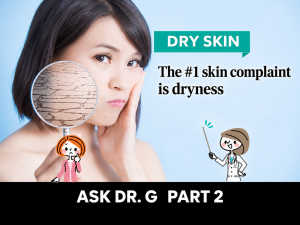
Dry Skin, and the Lines It Leaves Behind – The number one skin complaint — and why moisturizing harder isn’t fixing it
Last updated
November 7, 2026
| 8 min read
“My face feels tight all year round, and I’m starting to notice fine lines around my eyes and mouth. What do I do?”*
* A question sent in by one of our readers.
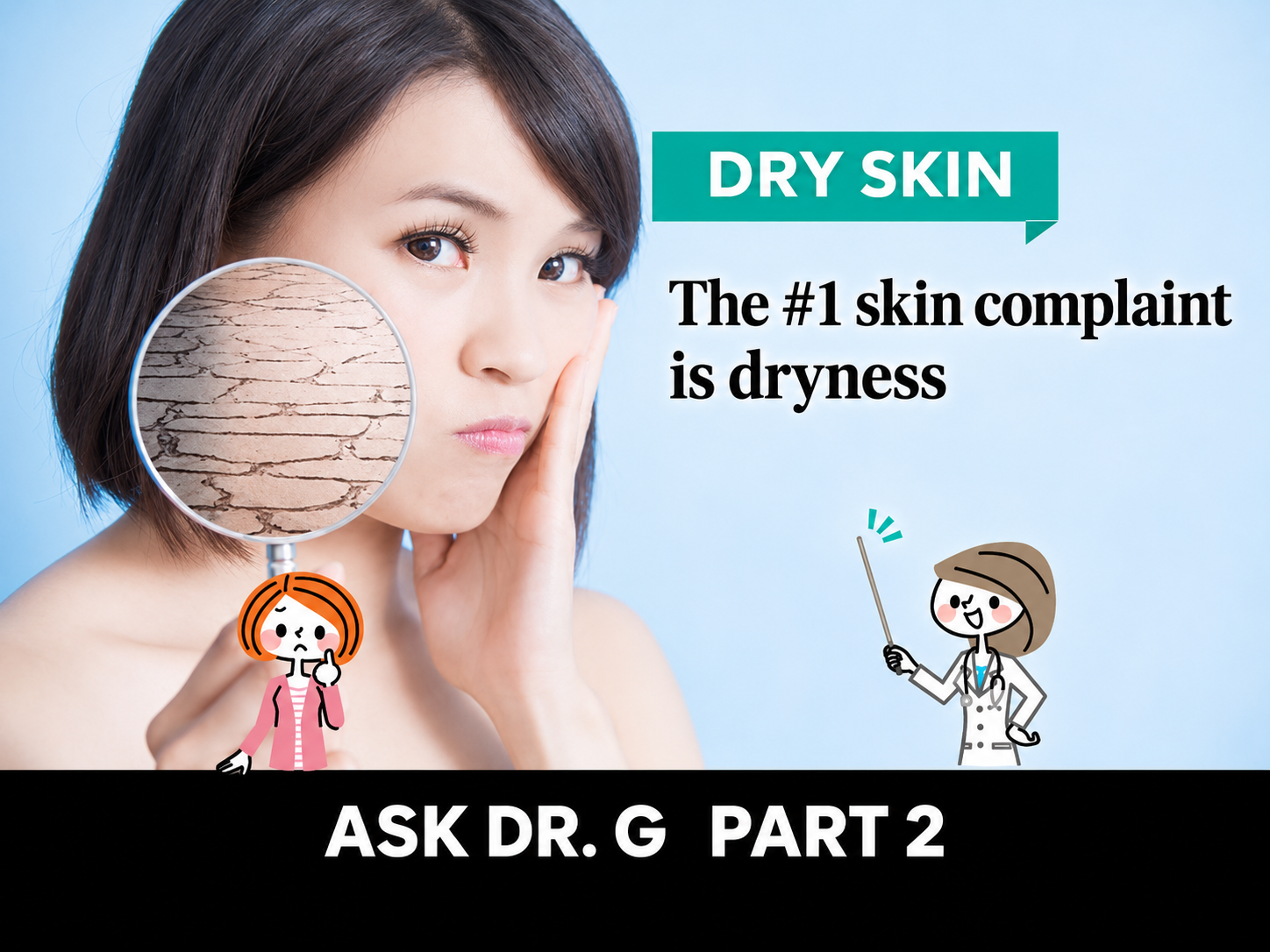
This one comes in more than any other question we get. For Part 2, Dr. G and I are going talk in depth about dry skin and the fine lines that come with it. Step one is finding out what dry skin actually is.
What dry skin actually means
BELLA I was sure I didn’t have any wrinkles yet.
Then I got close to a mirror and found a patch of fine lines under my lower eyelids. They’re worst in the late afternoon.
I moisturize properly every morning and the office air conditioning doesn’t help.
DR. G Dryness used to be only a fall and winter problem.
These days people fight it all 12 months out of the year.
You can’t have a conversation about skincare without “dry skin” coming up.
Understand what it actually means and you can graduate out of it.
Let’s start with what counts as dry skin in the first place.
BELLA Please! It’s the question readers send in most.
All my friends say “I have dry skin” — all of them, like dry is the new normal.
DR. G That tells you how closely dryness is tied to the condition of your skin.
Here’s the definition, and it’s narrower than people assume.
Dry skin is water evaporating out of the stratum corneum, the outermost layer.
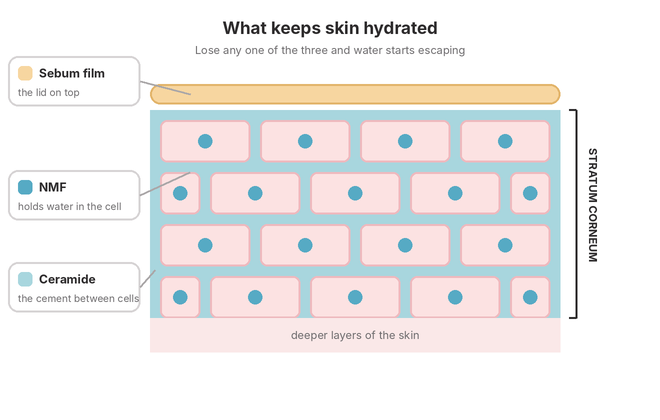
DR. G Holding that water takes 3 things working together: sebum, NMF — natural moisturizing factor — and ceramide, the main intercellular lipid. If you moisturize plenty and your skin is still dry, chances are those 3 are running short and your barrier function has dropped.
BELLA And a weaker barrier invites more dryness.
Which weakens the barrier further. That’s a loop going into dry skin city!
DR. G
Exactly.
Barrier function does 2 jobs at once: it stops water evaporating out of the stratum corneum, and it blocks irritants from getting in.
When it drops, foreign matter gets through more easily, and that can bring on itching and rough patches.
Ever had a skincare you’ve used for years suddenly started to sting? Sound familiar?
What causes it is rarely 1 thing.
Temperature and humidity swings, UV, poor circulation, the wrong skincare habits, hormones, turnover running off schedule.
They tangle together, cells take damage, and the skin’s power to hold moisture weakens.
Moisture needs all 3, not 2
BELLA
If even one of sebum, NMF or ceramide runs short, I’m headed for dry skin?
DR. G
Straight there.
And here’s the part nobody wants to hear — all 3 declines with age on their own. Sebum in your 40’s runs at about half what it did in your 20’s.
Which makes it a bad time to be reaching for blotting paper all day or washing with something harsh.
A lot of people don’t like the feeling of anything slick on their face, and that instinct is what gets them over-washing.
Unless you wash in a way that takes the dirt off and leaves the moisture behind, you strip out sebum you needed.
No sebum, no sebum film. No film, and irritation reaches the stratum corneum directly.
Sebum isn’t spread evenly across your face either. You know which areas produce the most?
BELLA
The T-zone and the U-zone. And the 2 lowest are around the eyes and around the mouth.
Now that I think about it — when I reach for a blotting paper, I press it around my eyes and mouth without thinking! *ugh* The two driest parts of my face!
DR. G
Noticing it is the whole point.
A lot of skincare is catching what your hands do on autopilot, before it costs you the 3 ingredients you can least afford to lose.
NMF — the one that goes first
DR. G
NMF is built from amino acids, lactic acid and similar components, and its job is holding onto water.
It’s the reason the water content inside your stratum corneum stays level. It’s also delicate — sun exposure, short sleep and stress all hit it, and it runs short fast.
Ceramide — the cement
BELLA
NMF sounds like a sensitive one.
Ceramide I know — that one’s on everything.
DR. G
Ceramide is the main component of the intercellular lipid.
It fills the space between the cells of the stratum corneum and glues them to each other, like cement between bricks.
Young, healthy skin has plenty of it.
BELLA
Which is why so much skincare aimed at older skin has ceramide in it.
DR. G
That’s it.
Take the cement out from between the bricks and you can picture what happens — water leaks, and barrier function drops with it.
Both NMF and ceramide are produced during epidermal turnover, which means turnover running off schedule drags NMF down too.
Skin that won’t hold moisture no matter how much you put on it is skin that has run out of both.
Fine lines are the warning signs
DR. G
Back to those fine lines under your eyes in the late afternoon.
Does your skin feel tight when that happens?
BELLA
It does, it does!
Tight enough that it almost feels like it’s cracking!
DR. G
That’s the warning sign for dry-skin lines.
Skin loses its flexibility when it dries out, and we keep using our faces — every expression pulls the skin and compresses it again. On skin with no give, that’s what carves fine lines on our face.
Leave it there and it reaches the dermis.
The groove deepens, and what was a fine line becomes a permanent one.
Careful moisturizing gets flexibility back, and it’s far easier before than after.
BELLA
It’s like… laundry, right?
I leave a load in the machine and forget to hang it, and what came out?
Clothes are creased with lines I can’t get out.
Gentle habits build skin that holds up
DR. G
Most people hear “moisturize” and think only about what goes on.
For dry skin, the cleansing step matters just as much.
Pick a makeup remover and a cleanser that aren’t stronger than they need to be, and when applying, skip the rubbing and the tapping.
Friction works against you.
Bella — you’ve told me you like hot showers. Are you rinsing your face in it?
BELLA
Guilty. A scorching steaming hot shower, and my face dives right in!
DR. G
Yeah… please stop that.
A strong shower aimed straight at your face at 108°F (42°C) or above is an irritant on dry skin. Turn the temperature down and rinse with lukewarm water instead.
BELLA
In my defense, I do the next part right!
Skin has no sebum film at all straight after washing, which is why I moisturize while it’s still damp. And I seal it with cream after the serum to keep the water from escaping.
DR. G
There’s a reason that sequence matters. The epidermis has no blood vessels in it, and research in recent years has found that nutrients travel through it with water — water moving through is part of how skin stays in good condition.
You could reasonably put your lotion on in the bathroom and you’ll be right!
Products carrying moisturizing ingredients — ceramide, hyaluronic acid, peptides — do more than products that only supply water and oil.
Choose skincare for the ingredients that condition the skin’s internal environment, not just the ones that wet it. Then press each layer in properly with your hands: lotion, serum, cream, one at a time.
BELLA
As Dr. G’s assistant: no more washing my face in hot comfy showers, and no more rushing through skincare.
Have a burning question? Email us at us@bglen.us with your question for Bella. We’ll research it — and yours might be the one we feature next.
What Bella uses
Everything above comes back to two things: wash without stripping and give your skin ingredients that hold water rather than just water itself. One product does most of the job.
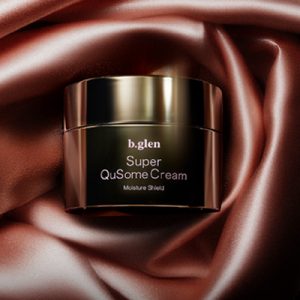
Super QuSome Cream — 33 g, $105, bglen.us only Limited Quantity – Free gift with purchase
The richest cream b.glen has made, and it’s built for exactly the skin in this article — the kind where moisturizer goes on and doesn’t hold.
What changes. Remember the three things that keep water in your skin? This puts two of them back. Ceramide NP is the cement between your cells. Hyaluronic acid holds onto water the way NMF does. That’s the leak, sealed. It melts into dry, tired skin and keeps it hydrated morning and night, and the tightness that turns up by mid-afternoon has a lot less reason to. Skin looks plumper because it’s holding water again instead of losing it by noon.
Who it’s for. Skin that’s gone dry enough to turn reactive — stinging at things that never used to sting — has CICA in here to calm it down. And if the fine lines all that dryness left behind bother you as much as the dryness did, the smoothing peptides and salmon PDRN are the reason to take this over the everyday cream.
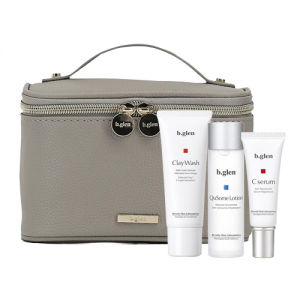
Free gift with the cream: the vanity pouch, plus travel sizes of the three steps below.
The rest of the routine
Clay Wash Montmorillonite clay lifts dirt off instead of stripping it off. Go back to the sebum section — the two lightest-sebum areas on your face are around your eyes and your mouth, which is exactly where dry-skin lines start. A cleanser you don’t have to scrub with protects the sebum you still have.
QuSome Lotion The step that goes on while skin is still damp, before the film has rebuilt. Press it in rather than patting.
C Serum Straight ascorbic acid, for the step between lotion and cream.
QuSome Moisture Rich Cream The everyday seal, for when the Super QuSome Cream runs out or you want something lighter. Ceramide NP is in here too — the “cement” from the diagram above — plus niacinamide and glutathione.