
“If I’m already using products that claim to work on dark spots, that also covers brightening your skin, right?”
Good question — and I completely understand this one. Dark spots and pigmentation sit at the top of my own list.
For Part 1, we’re learning about dark spots. “You can’t plan around an enemy you don’t understand.” (paraphrasing Sun Tzu, The Art of War)
Dark spots are melanin, it’s there to protect you
Many common dark spots are caused by excess melanin. UV light is strong enough to damage our DNA, and melanin is what your skin makes to shield itself from it. Melanin is the bodyguard here — please remember that. However, take in more UV than your skin can handle, and it starts producing melanin in bulk.
Normally melanin sheds with dead surface cells and nothing more. When your skin makes it faster than it can shed it, the extra can build up and appear as a dark spot.
UV isn’t the only trigger. Friction from rough skincare habits and stress both generate free radicals — and free radicals push melanin production too. Scrubbing your face hard. Stressing over a diet. Looking back, I’ve been a quiet melanin factory for years.
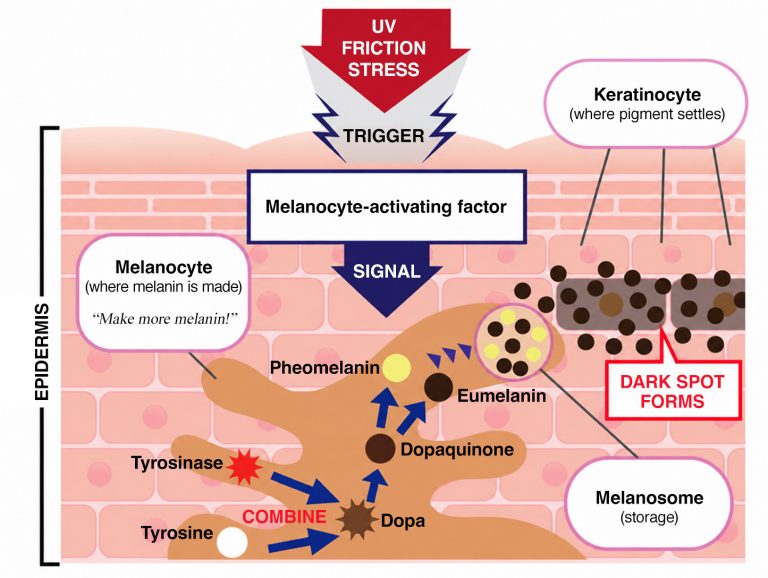
UV, friction and stress trigger the signal. Tyrosinase turns tyrosine into melanin, which is packed into melanosomes and handed up to the keratinocytes — where it shows.
Beating dark spots means slowing tyrosinase

Melanin forms when an enzyme called tyrosinase acts on an amino acid called tyrosine and turns it dark. When that pigment doesn’t clear out with your skin’s turnover, it stays. That’s your spot.
Which means: reduce tyrosinase activity, and you can help limit excess melanin production. I’m repeating what Dr. G told me, but it clicked — the real target of a dark spot routine is one enzyme.
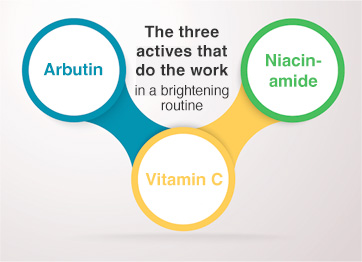
The three actives that do the work
Once you understand this, the ingredient list in b.glen’s brightening starter kit makes sense.
Arbutin goes straight at the enzyme. It suppresses tyrosinase activity, which means less melanin gets made in the first place.
Niacinamide works one step later. Look back at the diagram: melanin gets packed into melanosomes inside the melanocyte, then handed off to the keratinocytes above — which is where it actually becomes visible. Niacinamide interferes with that handoff, and less pigment reaches the surface.
Vitamin C is the antioxidant of the three. It neutralizes the free radicals that set off overproduction to begin with, and no brightening routine should be without it.
What about Hydroquinone? Hydroquinone comes up constantly in Japanese beauty media outlets about dark spots. It’s a different situation in the US: the FDA required over-the-counter hydroquinone products off the market in September 2020. The only FDA-approved drug containing hydroquinone is Tri-Luma, a prescription treatment for melasma. If you see hydroquinone being sold over the counter in the US, it isn’t being sold legally.
The most important part is sun protection

If you’re thinking “I already use arbutin, niacinamide and vitamin C” — hold on. There’s one step almost everyone lets slide. Dr. G is constantly on me about it.
Sunscreen.
Here’s what most people miss: serums and creams made to be applied on dark spots usually contain no sun protection at all. They weren’t designed to.
It’s easy to feel done because your skincare has the right actives in them. However, they are not enough on their own, and you need sun protection year round, not just in the summer.
UV levels climb hard starting in spring. Put a sunscreen lotion or cream in the routine and don’t skip it! However good your brightening products are, UV energy is stronger, and it will undo the work those actives are doing. The single most important thing you can do about dark spots is keep the sun off your face.
Signs it’s working

Back to the question we started with. “Using skincare that claims to work on dark spots” isn’t the entire skin brightening routine. Keep sun protection going all the time, use those actives mentioned earlier, and you’ve got a real shot at your spots. I’m done complaining about sunscreen. It’s the most important step.
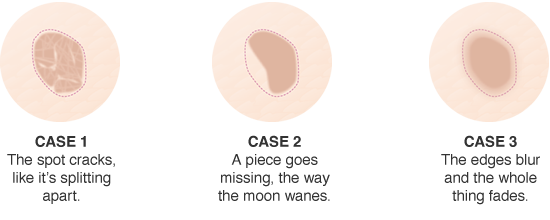
The hardest part is the daily upkeep — it gets old fast when you can’t see anything happening. Here’s what change looks like when brightening is working.
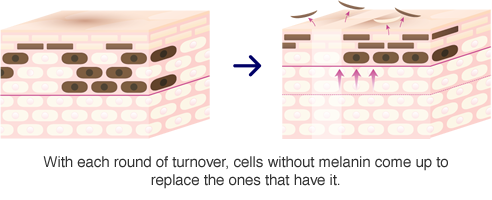
Look at the diagram: cycle after cycle, you’re slowly trading pigmented cells for clear ones. Watch for those signs, keep going, be patient, and let’s get through this together.
NEXT TIME
Dryness, and the fine lines that come with it. The number one skin complaint out there is dry skin. b.glenish! Bella & Dr. G as your guides.
What Bella uses
Everything points at the same 3 actives — arbutin, niacinamide and vitamin C — plus washing your face without roughing it up. The b.glen Brightening Starter Kit puts all of it in one box.
Montmorillonite clay lifts what’s on your skin instead of scrubbing it off. Go back to the first section: friction is one of the things that drives melanin production. A cleanser you don’t have to scrub with is the quiet part of brightening.
The hydrating step, carrying two stable vitamin C derivatives — 3-O-ethyl ascorbic acid and 3-laurylglyceryl ascorbate — and the antioxidant work starts early in the routine.
Straight ascorbic acid. This is vitamin C from the chart above, in its purest form.
Two of the three actives in one bottle: arbutin on the tyrosinase, niacinamide on the handoff to your surface cells. If you only take one product from this article, this is it.
Seals the routine in, with more niacinamide and glutathione, plus ceramide NP for the barrier.
And the part we keep coming back to: there’s no sunscreen in this kit, and there isn’t supposed to be. Pair it with the SPF you already own. Without that, the rest of it is working uphill.